
Props do not usually come off because of growth. They come off because something happened.
You touched bottom coming into a channel. You clipped a submerged log, a piece of debris, or a bar you did not see. Maybe you felt it, maybe you did not. Then the next time you ran the boat up, something was different: a vibration through the deck that was not there before, worse the faster you go.
That vibration is almost always a bent blade. A propeller is a balanced piece of equipment turning at high speed. Bend one blade even slightly and that balance is gone, and every minute you run on it that imbalance is working against your shaft, cutless bearing, strut, seals and transmission.
Barnacle King pulls props in the water, 24/7, across Southeast Florida. No haul-out, no travel lift, no waiting for a yard slot.
The prop is rarely the expensive part. What it damages next is.
An out-of-balance propeller transmits vibration straight down the shaft. Over time that accelerates wear on the cutless bearing, loads the strut, works the shaft seal, and puts stress through the coupling into the transmission. A repair that starts as a prop can become a shaft and running gear job if it is run long enough.
It also costs you on every trip in the meantime. A damaged prop loses efficiency, burns more fuel, and will not reach the speed it should.
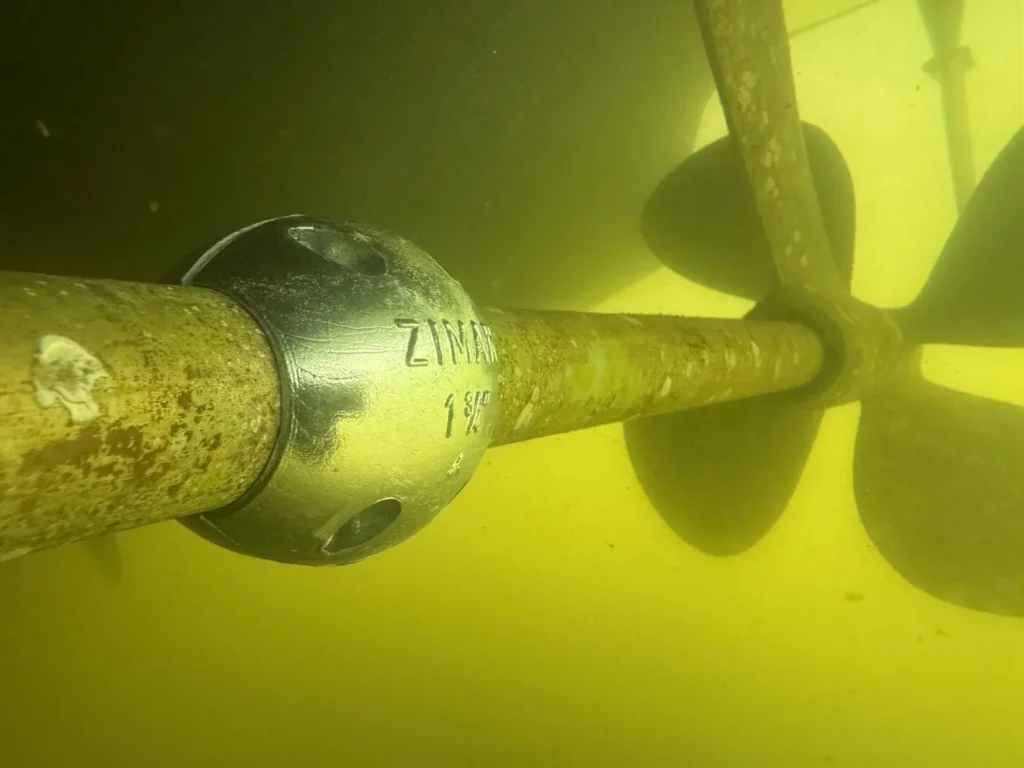
The tell is nearly always the same: a vibration that gets worse with speed, and was not there before. Sometimes there is a visible nick or curl on a blade tip. Often the bend is subtle enough that you cannot see it from the dock, and only a diver looking at the blade edge will find it.
That is a different problem, and worth being clear about because the two get confused.
A wrapped line, crab pot warp, net or piece of plastic is an entanglement, not prop damage. We clear those regularly, and for most of our clients it happens as part of a routine hull cleaning, because that is when a diver is already down there and finds it.
If you are wrapped and stuck right now, call us and we will get someone out. But entanglement usually does not require the prop to come off. Impact damage does.
Marinas and dockmasters often want proof of coverage before a diver goes in the water. We set out exactly what we carry, and what Ship Repairers Legal Liability actually covers, on our hull cleaning insurance page. If you would rather catch blade damage early, a diver is on your running gear every visit on a recurring protection plan.
Vibration that increases with engine speed and appeared suddenly after contact almost always points to a bent blade. Vibration that came on gradually is more often growth, a worn cutless bearing or shaft alignment. A diver can tell you which in a single inspection.
Yes. That is the entire point of in-water prop pulling. Our divers remove and reinstall props at your slip, which avoids the cost, scheduling and downtime of a haul-out.
We would not advise it. The imbalance is what causes further damage, and it works on the shaft, bearing, strut and transmission every hour the engine turns. Running to get home is one thing. Continuing to use the boat is how a prop repair becomes a running gear repair.
Many can be repaired. A prop shop can tune a bent blade back to true and rebalance the wheel, usually for considerably less than a replacement. It depends on how far the blade is bent and whether the hub or shaft is affected. We photograph the damage so you can make that call with information.
Yes. We run 24/7 across Broward, Miami-Dade, Palm Beach and Martin counties. Damage does not wait for business hours and neither do we.
Yes. We work with charter operators, commercial vessels and government-adjacent fleets, where downtime is the real cost. We carry $3,000,000 total per-occurrence liability including Ship Repairers Legal Liability, plus workers compensation and USL&H on every diver, and issue certificates of insurance on request.
Same service, any hour, in Fort Lauderdale, Miami, Palm Beach and Stuart.
Tell us what you need and where it is. A member of our team will call you to confirm.